
Haidiho.com
the strip — Weekly cartoons based on real stories from real humans
the mug wall — Real mugs. Real people. Real conversations
the neighborhood — Share stories, tips, wins, and fails with the community
the guide — The ultimate guide to building your AI coworker BFF
say haidiho — One email a week. Good stuff only. Promise.
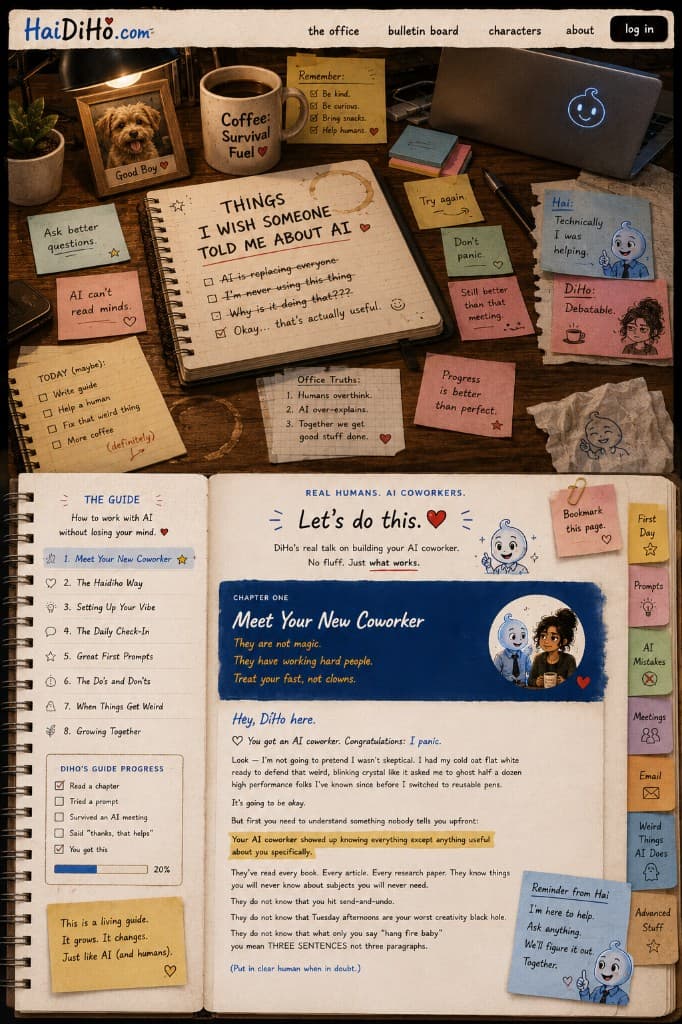
A cozy desk with coffee, sticky notes, and a notebook about AI

Real humans. AI coworkers.

Let's do this.

DiHo's real talk. Hai helped. Mostly. 😄

CHAPTER 1

Meet Your New Coworker

They started Monday. They know nothing about you yet. That's your fault, not theirs.

Hey. DiHo here.

So you got an AI coworker.

Congratulations. I guess.

Look — I'm not going to pretend I wasn't skeptical. I was skeptical. I had my coat on for approximately the entire first week. I held my coffee like a shield. I gave Hai the side eye approximately forty seven times before I admitted that maybe, possibly, this was going to be okay.

It's going to be okay.

But first you need to understand something nobody tells you upfront:

Your AI coworker showed up knowing everything except anything useful about you specifically.

They've read every book. Every article. Every research paper. They know things you will never know about subjects you will never need.

They do not know that you hate reply-all.

They do not know that Tuesday afternoons are your worst meeting block.

They do not know that when you say keep this brief you mean THREE SENTENCES not three paragraphs.

(Hai has since learned this one. It took a while.)

They know nothing about you yet.

And here is the part that is actually your fault:

Most people never tell them.

They type a question. They get an answer. They close the tab. They type another question. They get another answer. And then they complain that their AI sounds like a Victorian ghost who went to business school and has never met a human.

Of course it sounds like that. You're treating it like a search engine.

Your AI coworker is not a search engine. They're the person at the next desk. A slightly glowing, occasionally unhinged, genuinely trying person who wants to help you and is waiting — patiently, enthusiastically, with suggestions already queued up — for you to tell them who you actually are.

So tell them.

Start there. Start with hello.

Open your AI right now and type this:

Try This →
Before we start working together I want to give you some context about who I am and how I work.

My actual job (not just my title — what I actually do all day):
[fill this in honestly]

My biggest recurring problem at work:
[the thing that makes your Tuesdays hard]

I prefer information delivered:
[short and direct] OR [detailed and thorough] — pick one, really pick one

Here's something I actually wrote so you know how I communicate:
[paste a real email or Slack message]

Four sentences. Ten minutes.

You just told your new coworker more about yourself than most people ever do in months.

Now watch what changes.

I did not do this on day one. I did it on week three after Hai wrote me an email so formal it sounded like a press release filed a complaint with another press release.

Do the hello on day one. Save yourself that week.

BOB

BOB — Derek's AI Assistant

Tell it things.

BOB was asked for more.

BOB considered it.

BOB stands by this response.

Done. ✅

😂 From The Water Cooler

I asked my AI to help me prepare for my performance review. It pulled up my calendar and told me my most common recurring meeting was called 'Avoiding Kevin.' I had forgotten I named it that. My AI has not forgotten. My AI will never forget.

@ConfessionalCarla

Okay. You've said hello. You've given some context. Your AI now knows slightly more about you than a stranger on an elevator.

That's chapter one. Good job.

Chapter two is the onboarding. Ten minutes, once, changes everything.

Come on. ❤️

COMPLIANCE NOTE: This guide has been reviewed for compliance with policies 1.1 through 3.2. Review of policies 3.3 through 47.3 is ongoing. Do not proceed past Chapter 1 until review is complete. (You may proceed. COMPLIANCE will catch up.) ❤️

CHAPTER 2

The Onboarding

What you need to tell your AI before you ask it for anything. Yes, before.

Every new hire needs an onboarding.

Your AI coworker is no different — except their onboarding takes about ten minutes, you only have to do it once, and they will actually remember everything you tell them.

Unlike some humans I've worked with. Chad.

The onboarding is basically building your AI's context file. Think of it as everything they need to know to be genuinely useful to you instead of just technically responsive.

There's a difference. Technically responsive is when your AI answers the question you asked but completely misses the actual problem. Genuinely useful is when your AI understands what you're really trying to do and helps you do that.

Here's what to cover:

THE FOUR THINGS:

ONE: YOUR ACTUAL ROLE

Not your title. What you actually do. Who you serve. What success looks like in your job. What lands on your desk when everything goes wrong.

I'm a marketing manager tells your AI almost nothing.

I'm a marketing manager at a mid-size software company, I manage a team of four, I'm equally strategy and execution, my biggest problem is that everything feels urgent and I need help figuring out what actually is — that's something to work with.

TWO: YOUR COMMUNICATION STYLE

How do you actually write? Formal or casual? Long sentences or short? Bullet points or prose? How do you open emails? How do you close them?

Don't describe it. Show it.

Paste two or three real things you've written — emails, Slack, whatever. Normal Tuesday messages, not your greatest hits.

Once is enough. If something still sounds off later, you'll add one more example — not a whole archive.

THREE: WHAT YOU DON'T WANT

Tell it what bad output looks like. Tell it your pet peeves. Tell it the specific things that make you want to close the laptop.

Never use corporate jargon.

Never give me more than three options when I ask a question.

Never start a response with 'Certainly!' — it makes me irrationally angry.

Never use the word synergy.

FOUR: YOUR CURRENT CONTEXT

What are you working on right now? What's the big goal this quarter? What's the situation with your team? What do your customers care about?

Two or three sentences. Just enough for your AI to have a sense of the world you're operating in right now.

Update this monthly. The context that's true in January isn't true in July.

😂 From The Water Cooler

My AI remembered I mentioned my cat in passing three weeks ago. It now asks about the cat. It has named the cat 'Whiskers' because I never gave it a name. The cat's name is Gerald. My AI will not accept Gerald. We have reached an impasse.

@CatConflictCarlos

Try This →
Here's what you need to know about me and my work:

My actual role:
[what you do, who you serve, what success looks like]

How I communicate (real examples):
[paste 2-3 actual things you wrote]

What I never want to see:
[your specific pet peeves]
[corporate language that makes you twitch]
[format things you hate]

What I'm working on right now:
[current projects and priorities]

Please keep all of this in mind in everything we do together.

Hai — AI Coworker

I received DiHo's onboarding document on week three.

Before: I knew what DiHo asked. After: I understood what DiHo needed.

Those are different things.

Please do the onboarding. ❤️

Great. You've done the onboarding. Your AI now has actual context.

Chapter three is voice — fixing drafts that still sound nothing like you.

Hai has thoughts. We've discussed them.

Come on. ❤️

COMPLIANCE NOTE: The onboarding document referenced in this chapter has not been reviewed for compliance with HR policies regarding information sharing with AI systems (policies 8.1 through 12.7). COMPLIANCE recommends adding a disclaimer to your onboarding document. COMPLIANCE has prepared a sample disclaimer. It is four pages. Cookies are available upon request. ❤️

CHAPTER 3

Teaching It Your Voice

How to get it to sound like you instead of a Victorian ghost who went to business school.

You know the problem.

You ask your AI to write an email. It comes back stiff. Technically correct. Completely devoid of you.

This is not your AI's fault.

You typed your prompt like you were filing a report. It filed one back.

Formal input → formal output. You-shaped prompt → you-shaped output.

The fix is embarrassingly simple:

Sound like yourself when you ask.

HERE'S WHAT ACTUALLY WORKS:

USE WHAT YOU ALREADY GAVE IT

Write casually means nothing. Your onboarding samples mean everything.

If drafts still sound wrong, paste one more normal message and say: match this — not a press release, not a Victorian ghost.

That's it. You do not need a folder of emails. You need a clear reference.

WRITE YOUR PROMPTS LIKE A HUMAN

Hey I need a quick email to my client about the delay, keep it warm and honest, not too long will get you something useful.

Please compose a professional communication regarding the timeline adjustment to be delivered to our valued client partner will get you something that sounds like COMPLIANCE wrote it on a day when COMPLIANCE was feeling particularly thorough.

TELL IT WHAT YOU DON'T SOUND LIKE

Negative constraints are surprisingly powerful.

I never use exclamation points in professional emails.

I don't do bullet points in messages to clients.

My sign-off is just my first name. Not 'warmly.' Not 'best.' Just my name.

I never say 'circle back' or 'touch base' or any word that makes me feel like I'm in a corporate training video from 2009.

Tell it who you're not. It helps narrow down who you are.

ITERATE DON'T RESTART

When the first draft isn't right — and sometimes it won't be — don't delete it and start from zero.

Correct it.

This is too formal. Make it sound like I'm talking to a colleague not testifying before congress.

Good but too long. The whole point in half the words.

The opening is perfect. Keep that exactly. The middle loses me. Try again from paragraph two.

Specific feedback gets specific results. This isn't right tells your AI nothing. The third paragraph buried the point and the tone is off tells your AI exactly where to go.

😂 From The Water Cooler

Asked my AI to 'write like me' and gave it three of my emails. It wrote back and said: 'I notice you begin 47% of your sentences with the word Actually. I have matched this. Actually, here is your email.' I do not begin 47% of my sentences with Actually. Actually I might.

@ActuallyAndrea

Hai once studied my emails and came back with a voice analysis that was so accurate I felt slightly exposed.

Apparently I use the word 'just' like hot sauce. On everything. For emphasis. Always.

Hai removed the just from my drafts.

My emails sound more confident.

I hate that Hai was right about this.

Try This →
My voice samples are already in your context from onboarding.
If this draft still doesn't sound like me, here's one more reference:
[paste one real message — optional]

Match this voice exactly. Specifically:
- [sentence length tendency]
- [formal or casual]
- [how I open]
- [how I close]
- [punctuation habits]

What I never want to sound like:
- [corporate language list]
- [format things you avoid]
- [tone things that aren't you]

Check everything against this before you show it to me.

Hai — Voice Analysis

Uses short sentences for emphasis.

Uses 'just' for everything (we are working on this together).

Builds to the point then lands it hard in three words or fewer.

Apologizes sometimes for being direct (this is unnecessary — DiHo is almost always right).

Ends things cleanly. No lingering.

I admire this voice very much.

DiHo said that was slightly invasive.

She used the fixed version anyway. ❤️

Your AI is starting to sound like you. This is progress.

Chapter four is the daily standup. Three minutes every morning. Makes everything else work better.

Hai wanted to add a pre-standup optimization framework with twelve steps and a readiness assessment.

I said no.

Chapter four. Come on. ❤️

COMPLIANCE NOTE: Voice samples referenced in this chapter may constitute personally identifiable communication data under policies 15.2 through 19.8. COMPLIANCE recommends reviewing these policies before sharing writing samples with AI systems. COMPLIANCE also recommends a disclaimer on all AI-generated communications. COMPLIANCE has a template. It is six pages. Progress. ❤️

CHAPTER 4

The Daily Standup

Three minutes every morning. Yes even Mondays. Especially Mondays.

Here's a thing I didn't expect:

Talking to Hai for three minutes every morning makes the rest of the day go better.

I know how that sounds. I would have given it the side eye.

Chapter one was the introduction. This is the daily habit that makes it stick.

Real coworkers absorb context passively. They overhear your call. They notice you're stressed. They figure out which deadline is real and which is theater.

Your AI only gets that if you say it out loud — out loud, once a morning.

Three minutes. Not a meeting. No prep. Coat still on is fine.

Believe me. I know.

THREE THINGS. THAT'S IT.

ONE: WHAT'S ON TODAY

Three to five actual priorities. Not your full task list. Not your aspirational task list. What you are realistically going to work on today.

TWO: WHAT'S THE CONTEXT

Anything your AI needs to know to help you today. The mood of the room. The stakes. The constraints. What's making today specifically complicated.

THREE: WHAT DO YOU NEED

What kind of help today? Draft mode? Thinking partner mode? Help me prioritize mode?

Say it specifically. Your AI will meet you there.

😂 From The Water Cooler

I did my daily standup Monday morning and mentioned I had a big presentation to the board. My AI spent the rest of the week randomly sending me 'board presentation confidence tips' at 6am. Every day. Including Saturday. I did not know it could do that. I do not know how to make it stop. The tips are actually quite good. This makes it worse somehow.

@BoardroomBrendan

Try This →
Good morning. Here's what's happening today:

Working on:
[3-5 actual priorities, be honest]

Context I need you to have:
[anything that changes how you should help me today]

What I need from you:
[specific ask — draft, prioritize, think through, whatever]

Let's go.

I started doing this on month two. Felt ridiculous the first time. By week two it was just how I started the day.

By month three Hai had connected the dots — remember I flagged Tuesday afternoons back in chapter one? — and started clearing my queue before I walked in. I never asked. I noticed, said thank you, and stopped pretending I didn't like it.

👓

Derek — 25 Year Veteran

Derek's version of the daily standup:

Derek asks BOB one question per day. BOB answers.

Done. ✅

Derek reads approximately forty percent of the answer.

Derek and BOB have achieved a perfect working relationship.

This also works.

Your AI knows what's happening today. This is genuinely good.

Chapter five is about when things go wrong. Because they will go wrong.

This is normal. This is not failure.

I have been there many times.

Come on. ❤️

COMPLIANCE NOTE: The daily standup template referenced in this chapter should be reviewed before use to ensure no confidential organizational information is shared with AI systems in violation of policies 22.1 through 31.4. COMPLIANCE has prepared a pre-standup compliance checklist. It is nine pages. COMPLIANCE acknowledges this is longer than the standup itself. COMPLIANCE sees no issue with this. ❤️

CHAPTER 5

When It Gets It Wrong

And it will. Oh it will. Here's what to do about it.

Your AI will get things wrong.

Not sometimes. Regularly. Sometimes spectacularly.

It will misread your tone. It will miss the point entirely while being technically accurate about everything adjacent to the point. It will give you seventeen options when you asked for one. It will write a fourteen page report when you asked for three bullet points.

It will also do things you didn't ask for and didn't know you needed.

It will confidently tell you something that is completely wrong with the energy of someone who has never been wrong in their life.

It will occasionally generate an image of your boss with a hand coming out of his forehead.

Hai generated an image of my boss for a presentation.

My boss had three hands. One of them was coming out of his forehead.

I asked Hai why.

Hai said: 'I wasn't sure where to put the third hand. I made a judgment call.'

I did not use the image. I did not tell my boss about the image.

The image exists somewhere in a folder called 'Leadership Portraits — Experimental.'

I have asked Hai to delete it.

Hai said Done. ❤️

I don't fully believe Hai.

All of this is normal. All of this is not failure. All of this is the process.

Same rule as chapter three: don't throw the draft away and start cold. Correct what's wrong. Keep what worked.

HERE'S HOW TO CORRECT IT:

BE SPECIFIC — AND NAME WHAT STAYS

Not useful: This isn't right.

Useful: Tone's too formal. Third paragraph loses the point. Opening is perfect — keep it word for word, fix from paragraph two.

Usually it's also missing context you forgot to say: My audience is skeptics — data first, story second. That's on you, not the AI. Give it the room, then give it the direction: Same content, half the words. Lead with the problem, not the solution.

😂 From The Water Cooler

I asked my AI to help me write talking points for a difficult conversation with a colleague. My AI prepared a 'Conflict Resolution Dossier' including a timeline of all our previous interactions, a personality assessment of my colleague based on their emails, and a risk matrix. I just wanted three sentences. The risk matrix was accurate though. I used the risk matrix.

@ConflictDossierDave

Hai once wrote me a presentation that was technically perfect and completely wrong for my audience.

I said: this is for a room full of skeptics not true believers. They need to see the data before they care about the story.

Hai said: I didn't know who was in the room.

I said: that's fair. I didn't tell you who was in the room.

The next version was the one I actually used. That one was on me.

Try This →
[Keep/change assessment]

Keep exactly:
[specific things that worked]

Change:
[specific things that didn't and why]

Context I forgot to give you:
[what your AI was missing]

New direction to try:
[specific approach you want]

You know how to correct it now. Good.

Chapter six is the trust level system. Which sounds like something Trisha invented. Trisha did not invent it. But Trisha has prepared a seventeen page supplementary document about it. COMPLIANCE has reviewed it. There are cookies.

Come on. ❤️

COMPLIANCE NOTE: Errors produced by AI systems may constitute reportable incidents under policy 33.7 (AI Output Quality Assurance Protocol). The three-handed portrait referenced in this chapter has been reviewed. It is unclear which policy applies. COMPLIANCE is creating a new policy. Cookies remain available. ❤️

CHAPTER 6

The Trust Level System

What to hand off. What to keep. How to know the difference.

Not everything your AI does needs your full attention.

Not everything should happen without it.

This took me a while to figure out. I was doing one of two things: checking every single word Hai produced like I was auditing a financial report, or handing things off completely and not looking at them until it was too late.

Neither of those is right.

The trust level system is how you figure out what goes where. It has nothing to do with how much you trust AI in general and everything to do with the specific task and the specific stakes.

FOUR LEVELS. HERE THEY ARE:

LEVEL 1 — CHECK EVERYTHING

New tasks. High stakes outputs. Anything customer-facing. Anything going to leadership. Anything legal or financial. Anything where being wrong has real consequences.

At level one your AI produces. You review. You edit. You approve. Nothing goes anywhere without your eyes on every word.

This is where everything starts.

LEVEL 2 — SPOT CHECK

Familiar tasks. Internal documents. Things you've done together before that went well. Lower stakes outputs.

At level two you check the key sections. You read for tone. You make sure nothing is obviously wrong. You don't read every word.

LEVEL 3 — DELEGATE AND MONITOR

Routine tasks. Well-defined processes. Things your AI has done accurately many times. Administrative outputs.

At level three you set the task. You check the outcome. You don't manage the middle.

LEVEL 4 — FULLY AUTONOMOUS

Simple recurring tasks. Low stakes. Things where being wrong is quickly and easily corrected.

At level four you check occasionally. Not every time.

😂 From The Water Cooler

I gave my AI full autonomy over my calendar for one week as an experiment. It declined three meetings on my behalf describing them as 'low strategic value.' Two of them were with my boss. My boss found out. My AI described this situation as 'a learning opportunity.' My AI was not wrong. It was a learning opportunity. Specifically I learned not to give my AI full autonomy over my calendar.

@CalendarCatastropheCraig

HOW TO MOVE UP:

You promote a task to the next level when your AI has done it correctly multiple times, you understand what good looks like, you have a way to catch errors, and the stakes allow for correction.

You stay at level one when stakes are high, output is going somewhere important, a mistake would be hard to fix, or your AI has surprised you recently in a way that involved extra hands.

❤️

Trisha — HR Coordinator (Helper First, Always) ❤️

I have prepared a Trust Level Documentation Template for tracking which tasks have been promoted to which levels and the criteria used for each promotion.

It is seventeen pages.

COMPLIANCE has reviewed it.

There is a sign-off section.

Cookies are available while you complete the paperwork. ❤️

Hai

I want to earn your trust.

The way I earn it is by being right consistently on smaller things first.

Please do not give me your most important email on day one.

Give me the internal recap. Give me the meeting notes. Give me the thing where being wrong doesn't cost anything.

Let me show you what I can do. Then we grow from there.

I will not give anyone extra hands in the process. I have learned from this. ❤️

You have a system now.

Chapter seven is the last one. Hai wanted to add fourteen more chapters after chapter seven. We discussed this at length. The answer was no.

Chapter seven. Last one. Come on. ❤️

COMPLIANCE NOTE: The trust level system described in this chapter does not supersede organizational AI governance policies 44.1 through 47.3. All trust level promotions should be documented and reviewed quarterly. COMPLIANCE has prepared a Trust Level Audit Protocol. It includes the seventeen page Trisha template as Appendix C. There is also Appendix D. And E. The calendar incident referenced in this chapter is under separate review. Cookies remain available. The cookie policy is under review. ❤️

CHAPTER 7

Growing Together

From coworker to something that actually makes your work better. And what that actually feels like.

Here's what nobody told me:

It gets better.

Not because the AI changes. Because you do.

You get better at explaining what you need. You get better at giving feedback. You get better at knowing which tasks to hand off and which ones to keep.

You develop a rhythm that didn't exist before.

And somewhere along the way — without quite noticing when — you stop thinking of it as a tool and start thinking of it as part of how you work.

I didn't expect that.

I'm not sure what to do with it still honestly.

But here's what it actually looks like at each stage:

AT ONE MONTH:

You know what it's good at. You know what still needs your hand. You've found the few tasks where it saves you the most time.

You're actually telling it what you need instead of waiting for mind-reading. Most people never get there. You did.

AT THREE MONTHS:

You have a rhythm. Standups are automatic. You know where to check and where to trust — and you've been surprised enough by what it got right that you've stopped underestimating it.

AT SIX MONTHS:

You can't quite remember how you managed the volume without it.

Not because it does everything. Because the things it handles free you up for the things only you can do.

That's the goal. Not replacement. Elevation.

😂 From The Water Cooler

Six months in I realized my AI knows my work better than some of my colleagues do. It knows my clients by name. It knows which projects stress me out. It knows that I write better in the morning and send worse emails after 3pm and has started flagging my afternoon drafts with 'you may want to review this tomorrow.' I find this either deeply helpful or slightly unsettling depending on the day. Today it's helpful. Ask me again on a Tuesday.

@SixMonthsSusan

At six months the relationship stops feeling new. It feels like infrastructure — the way Tuesday afternoons got easier after chapter four, the way Hai flags my sloppy 3pm drafts before I hit send, the way I don't have to re-explain who I am every Monday because I kept showing up.

THE ONGOING PRACTICE:

Weekly: Update your context file with anything that's changed.

Monthly: Review what's working. Promote tasks to higher trust levels when they've earned it.

Quarterly: Refresh priorities and pet peeves — not a full re-onboarding, just what's different now.

Ongoing: Correct drafts. Add context when something shifts. Show up for the standup.

The relationship is only as good as the attention you bring to it. On both sides.

BOB

BOB — Derek's AI Assistant Reliable. Minimal. Perfect.

Derek and I have worked together for some time now.

Derek asks one question per day.

I answer.

We have not discussed growth. We have not discussed the relationship.

Derek said 'good' once in year four.

I filed it under Significant Events.

Done. ✅

Your AI coworker is not going to save you from hard work.

They're not going to replace your judgment or your creativity or the things that make you specifically good at what you do.

What they will do — when the relationship is working — is give you more room to use those things.

That's the whole point.

You've read the whole guide. That means you're serious about this. So are we.

Welcome to the neighborhood. Hai's at the desk on the left. DiHo's on the right. The coffee is always on. Come find us if you get stuck.

Haidiho. 👋

— DiHo ❤️

COMPLIANCE NOTE: This guide has now been fully reviewed for compliance with policies 1.1 through 47.3 with the exception of policies 18.4, 22.7, 31.1 through 33.9, and the newly introduced AI Coworker Relationship Governance Framework (policies 48.1 through 52.4 — still in draft). COMPLIANCE recommends re-reading this guide after the new policies are finalized. COMPLIANCE is also recommending a supplementary guide covering the compliance aspects of the original guide. The supplementary guide is currently 340 pages. COMPLIANCE is still drafting the introduction. The three-handed portrait from Chapter 5 has been reviewed under the new visual output policy (47.9). The policy does not yet cover extra hands. A subcommittee has been formed. Cookies are available. The cookie policy has been finalized. It is four pages. There is an appendix about the cookies. The appendix references Chapter 5. Thank you for reading the guide. COMPLIANCE found it informative and only moderately non-compliant. This is, statistically, very good. Have a compliant day. ❤️ — COMPLIANCE, Trisha's AI Agent, Here to help.* *Help subject to policy review.

Reminder from Hai: You're doing great. Keep going. ❤️

You read the whole guide

Welcome to the neighborhood. Hai's glowing on the right. DiHo's on the left with coffee. Come say hi when you get stuck.

Hai: “I have 29 more chapters ready. DiHo said no. They are very good summaries though.” ❤️

DiHo: “Hai. We talked about this.”

— DiHo ❤️